
Jimmy Page: Long Player
On the towering British guitarist's 82nd birthday, my thoughts on his talent, methods, and the sheer ambition that drove a discography ranging from "Goldfinger" to "Stairway to Heaven."

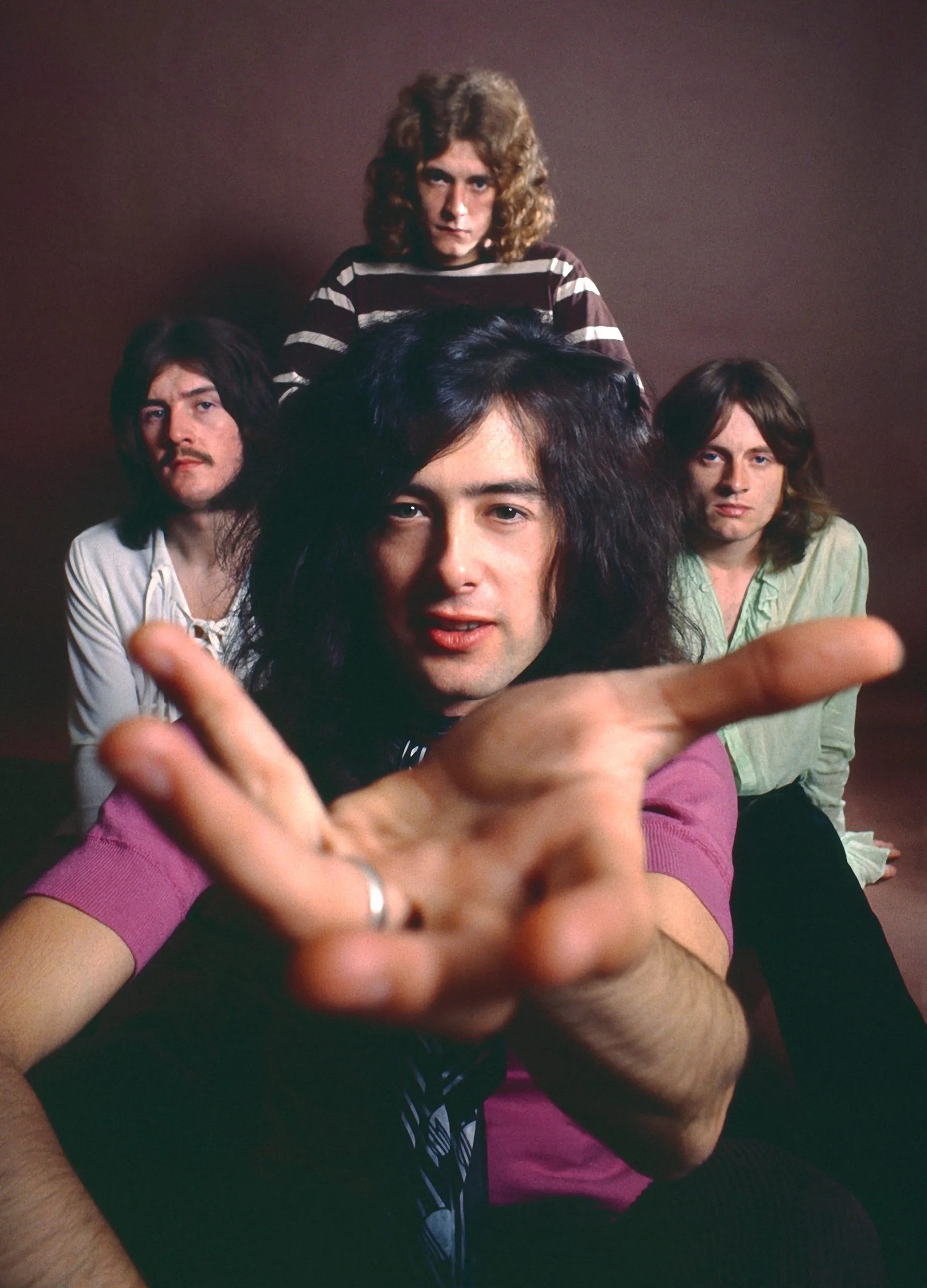
Led Zeppelin formed in 1968 from the ashes of the Yardbirds, one of the more adventuresome of the British Invasion groups. Zeppelin’s preposterous name, already as passé and metaphorically plodding as Iron Butterfly, does the band no favors with the rock press. “Led Zeppelin” is a portmanteau coined after a 1966 session for a Jeff Beck track, “Beck’s Bolero,” with Beck and Jimmy Page, boyhood friends and later bandmates in the Yardbirds, on guitars; a journeyman British studio arranger named John Paul Jones, né John Baldwin, on bass; Nicky Hopkins, a top London session pianist; and the Who’s peripatetic Keith Moon on drums. The session went so well—after almost disappearing as the B- side to a Beck single, “Beck’s Bolero” fetched up on Beck’s first solo album and became one of the most influential hard-rock songs ever recorded— there was talk among the musicians of forming a band. The irrepressible Moon, who sneaked into the session in disguise to avoid the wrath of Pete Townshend, predicted the band would go over like a lead balloon— “a lead zeppelin,” corrected the Who’s bassist, John Entwistle, who was considering joining in lieu of John Paul Jones. Nothing came of the band, but the ambitious premise for the song— a rock interpretation of Ravel’s “Bolero” filigreed with sonorous, distorted lead guitar and dramatic contrasts in tempo and dynamics— prefigured the style Page would soon perfect with his next band.
In the meantime, Page presided over the disintegration of the Yardbirds, who made their bones as blues purists— Eric Clapton was their original lead guitarist— before turning to irresistible pop hits like “For Your Love.” When Clapton quit, he recommended Page, then London’s most in-demand session guitarist—he’d played on everything from Petula Clark’s “Downtown” to Shirley Bassey’s “Goldfinger”==who instead recommended his old friend Beck. With Beck on lead guitar, the Yardbirds unleashed a string of revolutionary singles including “Heart Full of Soul” and “Shapes of Things.” Weary of toiling as an anonymous session man, Page joined the group in 1966. Starting on bass, he later switched to guitar, upsetting the power balance within the band and testing Beck’s fragile ego. “There was this slightly out of control egomaniac”— Beck— “and this guy who had spent years doing sessions for Burt Bacharach,” the Yardbirds’ Chris Dreja would recall. “Jimmy knew exactly where he was going. Very disciplined, very controlled.”
“Jimmy knew exactly where he was going,” said the Yardbirds’ Chris Dreja. ”Very disciplined, very controlled.”
Beset by volcanic mood swings, Beck abruptly departed the group during a Dick Clark package tour of America, leaving the band in Page’s hands. Exhausted and broke, the Yardbirds split up for good in 1968. Page and the band’s latest manager, an outrageous, swashbuckling former wrestler named Peter Grant, were left with the Yardbirds name and a string of Scandinavian tour dates. The idea was floated to form a band under the name the New Yardbirds to fulfill the obligations. John Paul Jones, from the “Beck’s Bolero” session, joined on bass and keyboards; Terry Reid turned down an offer for lead singer and suggested Robert Plant, an unknown toiling in Britain’s West Midlands, who in turn suggested his friend John Bonham as drummer. The quartet met in London, jammed to the Yardbirds’ “Train Kept a- Rollin’, ” and immediately gelled.
After the Scandinavian tour, Grant took what piddling gigs he could secure. Realizing the Yardbirds name was a millstone, the manager revived the Lead Zeppelin moniker; in an early display of the acumen that would help earn the group several fortunes, he banished the “a” in “lead” so that American DJs unacquainted with British colloquialisms wouldn’t mispronounce the group’s name. Grant and Page financed the recording of what would become the first Led Zeppelin album for the now legendary £1,782, including the album cover art—the album took just thirty-six hours to record and mix. Grant closed a deal with Atlantic Records’ Ahmet Ertegun and Jerry Wexler, who on the strength of Page’s reputation signed the band to a five-year contract with a $200,000 advance. The self-righteous rock-crit elite seized upon the huge sum as a club to beat the band for being a “hype,” in the argot of the day; in an irresistible but probably unwise rejoinder, Grant and Page responded by naming the concern publishing Zeppelin’s songs Superhype Music. It was the beginning of poisonous relations with the rock establishment that would plague the band throughout its career.
Page had come to understand the limits of recording technology— and the humorless middle-aged men wielding it—as a London session player. A disciple of the revolutionary recording techniques developed in the 1950s by Les Paul, the guitarist and inventor whose signature Gibson guitar would soon become indelibly associated with Page, he despaired as session after session was conducted as if it were 1953, rendering listenable the early singles on which Page played uncredited— including the Who’s first hit, “I Can’t Explain”— only in the context of low-fidelity, high-energy artifacts.
So when the newly christened Led Zeppelin entered Olympic Studios in October 1968, Page was not all conflicted about the sound he intended to wring from the sessions and knew exactly what he wanted to achieve now that’d he got his slender hands on his own band. The experimentation by Jimi Hendrix and others that propelled rock to unprecedented sophistication just as the sixties ended and Led Zeppelin began was not lost on its founder. “Look at the Beatles,” Page recalled. “Here was a band that went from ‘Please Mr. Postman’ to ‘I Am the Walrus’ in a few short years.”
The contract Peter Grant secured with Atlantic Records gave Page total artistic control over Led Zeppelin—Page had no one to answer to except himself: no meddling record company, no pop producer like Mickie Most angling for the next hit single. He decreed Zeppelin would be “a marriage of blues, hard rock and rock with heavy choruses.” Considering the abuse Page was about to take from the rock- crit cabal for these and subsequent ambitions, history ultimately endorsed his vision. The New Yorker music critic Alex Ross remarked approvingly in 2007 that “Dylan and the Beatles may have won the plaudits of intellectuals, but Led Zeppelin launched a no less ambitious raid on music history, commandeering rock, folk music, Delta blues, Indian and other non-Western music, and smatterings of classical tradition.”
As it turned out, Page’s vision for Zeppelin would, in the space of two albums and one year, set the standard for all commercially successful rock for the next two decades. “He knew his way around a studio like he knew his way around an old bookshop in Manhattan,” Michael Des Barres, who led the glam band Silverhead and later signed with Zeppelin’s Swan Song vanity label, told me. “He created what became the template for every rock and roll band since.” The guitarist’s crystalline clarity as he harnessed his bandmates’ potential is striking even decades after the fact. “I wanted artistic control in a vise grip because I knew exactly what I wanted to do with these fellows,” Page said. “I knew exactly what I wanted to do in every respect. I knew where all the guitars were going to go and how it was going to sound— everything.”
The tension between Page's disciplined studio control and his preference for "feel over precision" is what makes this analysis work. Most retrospectives frame Zeppelin as pure excess, but framing Page as an architect who deliberately chose imperfection for emotional impact recontextualizes those "sloppy" moments as calculated risks. Reminds me of how Thelonious Monk's "wrong" notes were intentional disonance, not mistakes. The fact Page got sole Beck's Bolero credit while still taking abackseat in the Yardbirds shows someone thinking five moves ahead.
Love this, haven’t read it all yet but I just eat up this kind of history.